Thursday, December 20, 2012

jQuery, MediaWiki 1.20, tabs and other news

About a year ago, Expression pages were modified to show only one language at a time. This was explained in this blog post. Some feedback I had was that the little arrow indicating a dropdown list (when hovering over it) was not obvious for new people. So I have changed the dropdown list to a tab system, that is visible without any hovering. This can be seen in http://www.omegawiki.org/Expression:India .

Apart from that, the "identical meaning" checkbox has been changed to "=" or "≈" that is selected with a combobox. The main advantage is to solve a bug that we had with the checkbox. Also, it is believed that "=/≈" is easier to understand.
Basically, the idea behind "identical meaning" is that when an exact translation ("=") for a concept does not exist in a given language, the contributors can suggest approximate translations ("≈") that are the closest to the concept in that language.

From the technical side,
OmegaWiki has just been updated to MediaWiki 1.20. Also, a month ago, several javascript functions of OmegaWiki were changed to use jQuery. We don't have enough programmers to implement many wonderful new features (any volunteer?) but at least we try to keep up-to-date with the latest versions of MediaWiki.

From the lexical side,
we now have about 46.000 concepts translated with 470.000 words in 419 languages.
The main language is still English with 48.000 words. I would be happy to reach the 50.000 milestone. We are constantly adding new words but at the same time, we delete "sum of parts" definitions like "ecosystem preservation" = "the preservation of ecosystem" (coming from the GEMET data), and other dummy entries about languages that were created during an other import of data.

Other languages above 10.000 words are Spanish (35610), French (29919), German (29872), Dutch(27402), Italian (17117), Portuguese (15163), Finnish (12694), Swedish (12439), Polish (11776) and Russian (10236).

We also have about 1800 images illustrating our 46.000 concepts, and more than 15.000 links to Wikipedia articles.


Thank you to all contributors.

Saturday, September 22, 2012

OmegaWiki is back online


It was apparently a problem with a disk not being recognized.

No data was lost, everything is fine.


Friday, September 21, 2012

OmegaWiki is offline


 Since yesterday afternoon (European time), the OmegaWiki server is not responsive.

 The exact cause is not yet known, but it seems to be a problem with the hardware (could be network card, hard disk, cpu, motherboard, or a combination of these), and I have personally no access to the physical server.

 As a precautionary measure, if anyone has a recent dump (either the full dump or the lexical dump), please tell me. My most recent dump is from the 3rd of September.

 In the meantime, it would be nice to update the page at http://meta.wikimedia.org/wiki/OmegaWiki , as requested by Sj (cf. http://meta.wikimedia.org/wiki/User_talk:Sj#OmegaWiki ) as a step towards potentially obtaining a support from the Wikimedia Foundation.

 Otherwise, just take a break and enjoy the week-end.

Monday, July 09, 2012

The OmegaWiki Visual Dictionary


Sometimes the best way to describe the meaning of a word is to show a picture of what it represents. But sometimes you need to go the other way: you have a picture of something in your mind and you need to find the word for it.
For example, what do you call the thing in a multi-speed bicycle that moves the chain from one set of gears to another?
bicycle-hover-example..PNG
In OmegaWiki we have a new set of pages of pictures with labels. When you hover with your mouse over one of the labeled parts of the picture, the word for it appears. If you click on the labeled part, you are taken to the Defined Meaning page of the word, where you can see its definitions, synonyms and translations in other languages. The labels are in your default language, but you can switch to another version of the picture using the language links in the left column.
You can access an index of the Visual Dictionary here. Our first pictures are of a human skull, a flower, a bicycle, a tugboat, and a family tree.
A family tree is a good way to visualize the meaning of kinship terms. Did you know that Turkish has many specific kinship terms such as "dünür", which means "parent-in-law of a person's child"? You can see them all in the Visual Dictionary in this diagram.
Commons has many language-neutral, labeled diagrams at [1] that can be readily used in the OmegaWiki Visual Dictionary. If you are familiar with the terminology of one of those pictures, feel free to import it into OmegaWiki. You may want to look at our help page on how to create such labeled diagrams.

Saturday, March 24, 2012

Installing and developing OmegaWiki made easier

Since several people willing to help already lost their courage during installation - when it was asked to install the 700MB-big SQL database - I have created an install script that automatically creates a minimal Wikidata (OmegaWiki) database.

The steps are explained at the following page:
http://www.omegawiki.org/Help:Installing_Wikidata_from_scratch

Instead of several hours, it now takes a few minutes to have a working development version of OmegaWiki.

For those who wants to have a true copy of the OmegaWiki website, with the entire data, this is still possible and explained at:
http://www.omegawiki.org/Help:Installing_Wikidata_with_an_existing_database

For those people out there who have been complaining about missing features for the last 5 years or so: I am sure that in 5 years you have had largely enough time to learn PHP and MySql, and you will now be able to easily and happily develop the features yourself!! :-)

Tuesday, February 28, 2012

Ithkuil language added to OmegaWiki

Ithkuil is a constructed language which is different from other constructed languages. In “classical” constructed languages, like Esperanto, the vocabulary and grammar is based on existing languages, so that people who know some languages can easily learn and use the constructed language with people from other countries.

On the contrary, Ithkuil starts from the idea that existing languages limit the way people can express their thoughts. Therefore, instead of being based on existing languages, the Ithkuil grammar and vocabulary is constructed to correspond to how we think, and to make it possible to express the subtleties of human reasonings or feelings in a logical and concise way.


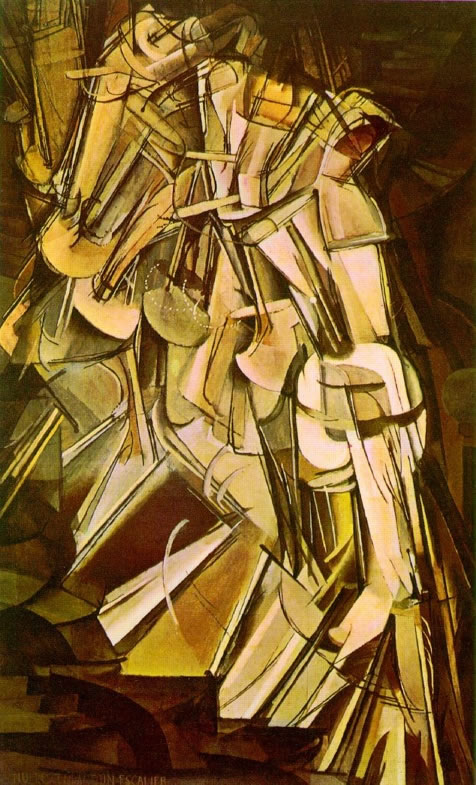
For example, if you would like to describe in Ithkuil the abstract painting of Marcel Duchamp: “Nude Descending a Staircase, No. 2” (above), you would logically follow the steps explained at http://ithkuil.net/texts.html#duchamp to construct the sentence, and obtain something like this:

which is pronunced quite shortly:

Aukkras  êqutta  ogvëuļa  tnou’elkwa  pal-lši  augwaikštülnàmbu.

but actually the equivalent in English is not concise at all:
‘An imaginary representation of a nude woman in the midst of descending a staircase in a step-by-step series of tightly-integrated ambulatory bodily movements which combine into a three-dimensional wake behind her, forming a timeless, emergent whole to be considered intellectually, emotionally and aesthetically.’

As can be seen above, the Ithkuil has its own nice script. However, this script is not available in UTF8 and therefore cannot be used in OmegaWiki. The people who use Ithkuil actually use the romanized form on forums, facebook, etc. , which is also what we use at OmegaWiki. This is why the language is actually called "Ithkuil (romanized)".

Some words in Ithkuil:
-
ithkuîl ( the language itself )
-
pʰal ( a tree )
Ithkuil also uses the bustrophedon writing http://en.wikipedia.org/wiki/Boustrophedon, where the first line is written from left to right, the second line from right to left, etc. like a snake. This is unfortunately not yet supported by modern browsers.

Saturday, January 07, 2012

One language at a time

Some words (or expressions) are spelled the same in many languages. For example "India" is translated as "India" in tens of languages.

OmegaWiki used to load all these languages and display them in one page. This resulted in a few minutes of lag while the server was loading all the necessary data (also slowing down requests from other users), and in a huge page with many redundant and unnecessary data. This was even worse if a user decides to edit such a page.

From now on, an expression page displays only one language at a time, and a combobox appears to switch to other languages when the cursor hovers over the language name (see picture).


It also works while editing or viewing the history of a page. As expected, the server does not lag anymore for such a page. Gerard told me that Nauru has even more languages. Now you can click it without fear :-)

A nice side-effect is the possibility to link to a word in a specific language.
For example:
- http://www.omegawiki.org/index.php?title=Expression:main&explang=85 for the English word "main"
- http://www.omegawiki.org/index.php?title=Expression:main&explang=86 for the French word "main".


Coming next will be the possibility to filter which languages are shown in the translation tables and definitions, according to what the user wants to see.

Wednesday, December 14, 2011

More than 1000 images

In February 2011, the possibility to add images to OmegaWiki was implemented. A few months later, we have already more than 1000 images. Images help to understand definitions and are an important feature of (online) dictionaries.

In OmegaWiki, when an image is added, it is attached to a particular concept, and is then displayed for all words representing that concept. Compared to Wiktionary where you would need to add an image of a concept for each page of each synonym, and for each page of each language, there is a lot of redundant work that is avoided.

As of today, there are about 47.000 concepts in OmegaWiki. It means that more than 2% of them have an image. It is not clear what percentage can be reached. Several concepts are abstract (feelings, reasonings), and other are verbs or names of languages and are hard to illustrate.

I find it particularly useful when a word with different meanings has different images, such as vampire, bluebottle, Mars, Venus, etc. Also interesting is to find an illustration for abstract concepts. This is sometimes possible: season, wake up or cheapskate.


P.S.: we have also almost 15.000 links to Wikipedia articles :-)

Sunday, November 27, 2011

Selecting the interface language

OmegaWiki tries to be as multilingual as possible in that its data is multilingual, and its interface can be displayed in any language supported by MediaWiki (more than 300 languages).

I've just added a combobox on the left to change the language of the interface. Previously, you had to create an account and change it in your preferences. Now, anonymous users can also change the language.

A nice feature is that when you set the interface language in your language, the definitions will be shown preferably in your language as well, when available.


I do not speak all languages, so I cannot test everything. Therefore I ask the question:
Is your language displayed correctly?

Thanks,
Kipcool

Sunday, November 06, 2011

The Glosbe dictionary uses our data

Glosbe.com is a multilingual dictionary where many bilingual translation dictionaries are available. It started earlier this year, and already have an impressive number of translations.

Their data come from several freely available online resources, including OmegaWiki. For example, the many words I have added in Bavarian are there:
http://glosbe.com/bar/en/essn

It also shows definitions from OmegaWiki, and inflexion tables from Wiktionary.
They have managed somehow to merge all these sources, and present them in an organized manner. For an example of a page with many sources involved, see: http://glosbe.com/fr/en/manger

Furthermore, Glosbe is also a translation memory, and they claim to have gathered more than 1 billion sentences already. I think this is a great resource for translators. New features will come in the future, they told me.

It is always nice to learn that someone uses our data. It makes our work meaningful!

Tuesday, October 25, 2011

OmegaWiki, Wiktionary and the Wikimedia Foundation

Many people still ask me:
  • What is the point of OmegaWiki if we already have Wiktionary?
  • Why is OmegaWiki not a Wikimedia Foundation project?
  • When will OmegaWiki replace the Wiktionarys?
So I'll write my answers in this blog post, so that I can easily refer people to it when they ask ;-)

Why OmegaWiki was created

The idea of OmegaWiki came to several multilingual contributors to Wiktionary, somewhere around 2004.
In Wiktionary, when you want to add a French=>English translation, you would edit the French word at the French Wiktionary, and add the translation. If you want that the English Wiktionary also has your translation, you'll have to edit the French word at the English Wiktionary and add your translation.
You'll probably also want to add the same translation in the other direction, i.e. English=>French. This means that two more pages have to be edited. So, basically to indicate that a French word XX and an English word YY express the same concept, you'll have to edit 4 pages to be complete. Now, consider that there are 170 Wiktionaries as of today... There is much redundant work involved.
The same will happen if you want to add relations, such as hypernyms. Even though hypernyms are based on semantics, and are therefore (more or less) independent of languages, you'll have to edit all the Wiktionaries one by one to enter such a relation.
The idea of OmegaWiki is therefore to be based on concepts (what we call DefinedMeaning). You'll only need to edit that concept once to indicate that a French word XX and an English word YY are representing this concept.

So, OmegaWiki is created

Around 2007, the first prototype version of OmegaWiki came online (at the time, it was called WiktionaryZ, but renamed later on because it is not a WMF project).
Concerns were expressed such as:
  • I contributed so much data to Wiktionary, I want this data to be automatically imported before I come to OmegaWiki
  • it lacks a lot of features that I'd like to see before I come from Wiktionary (e.g. inflexions table which we still don't have)
  • discussions on such a multilingual project will be obviously mainly held in English, and my English is not good enough, so I prefer to stay on my language version of Wiktionary
Then, we had no programmer anymore to implement new features.

OmegaWiki is not a WMF project

OmegaWiki was created with the idea of becoming a project of the Wikimedia Foundation.
Its software is an extension of MediaWiki called Wikidata. The source code is stored on the WMF servers.
Its community is mostly made of people who came from Wiktionary and still contribute to other WMF projects (Wikipedia, Wikisource, etc.). So we are not so far away from the WMF...
However it has been said that OmegaWiki can become a WMF project only if it has already all the features of the Wiktionaries, and if it is decided whether OmegaWiki will replace the Wiktionaries or coexist with them.
This is problematic, because replacing the Wiktionaries means performing an automatic import, which is not possible. Coexisting with the Wiktionaries means that there are two projects with similar scopes supported by the WMF.
Having more features before becoming a WMF project is also a bit of a catch-22: becoming a WMF project would give us dedicated programmers who would add the needed features... In that respect, it would be nice to become a WMF project, even without the need to implement whatever missing features. We would also be happy to be hosted on the WMF servers, for a faster website.
The discussion on Meta is still open for comments and waiting for a decision. Cf. Requests for comment/Adopt OmegaWiki

What about an automatic import of Wiktionary?

So you want to import the Wiktionary(ies). Which Wiktionary?
  1. All!
    Then, you need to merge the data representing the same concepts from the different Wiktionaries. There is no easy way to do that with 170 Wiktionary each having its own structure.
  2. Only the English Wiktionary
    Because it is the biggest! Then, what do you do with the other Wiktionaries?
Also, importing the English Wiktionary alone, which would be a good start, is already not straightforward at all.
For example, one of the definitions of the word "medicine" at Wiktionary is A treatment or cure. Defining a word by using synonyms is not allowed at OmegaWiki, because all synonyms share the same definition, and you cannot define "cure" as a treatment or cure. So, the definition needs to be changed.
Furthermore, the page "medicine" at Wiktionary shows a list of translations in other languages for that concept. Other lists of other translations for the same concept will/could be found at the pages "treatment" and "cure". These lists need to be merged in order to be imported to OmegaWiki.

Doing it automatically, if feasible, is a lot of work. Doing it manually, i.e. checking whether the concept is already there and rewriting the definition where necessary, is totally possible: we have already achieved much with very few contributors.
Furthermore, some of the data such as IPA, gender, pinyin, declensions and conjugation tables, could be imported with a bot in the future.

My two cents,
Kipcool.

Monday, October 17, 2011

A better table sorting

Some languages, such as French, German, Spanish, and many others use diacritics: é, í, ü, etc.

The normal sort function available in Javascript considers that any letter with a diacritic should be sorted after z. It was a bit annoying when using the French interface because the language names were not sorted as expected: "gaélique écossais" after "gallois", "géorgien" after "grec", and "hébreu" after "hongrois".

As can be seen on the following screenshot, this has been corrected (red dots identify languages which are now correctly sorted).


Friday, October 14, 2011

The combobox does not ignore you

If you have edited OmegaWiki, you probably know about this annoying little bug where you want to select a language, type in some letters, but the list of languages that appears ignores the letters that you typed. This happened particularly when the server is busy. The "solution" was then to either add an extra letter, or remove one and put it back to make the system aware that you typed something.

Well, this bug has just been solved!

Now, when the combobox has finished displaying its list, it compares it with what is now typed in the field, and if something new has been typed, it refreshes the list consequently; and you get less annoyed.

As an experimental experiment, I have also changed the delay between when you type and when the list is generated to 100ms instead of 500ms.

Feedbacks welcome.

Wednesday, August 03, 2011

The Check Spambots extension

We have recently opened the editing for anonymous users. As a consequence, we are spammed a lot more...

In the last days in particular, we have had in particular many spams from different IPs on a single page (but it is not so much of a problem because spambots are not capable of editing Wikidata pages, due to their different structure).

The website http://www.stopforumspam.com/ keeps an updated list of IPs that are spamming various websites, and all the IPs who spammed us on that day where already in their database. Therefore, it makes sense to use their data.

I knew the possibility to import Stopforumspam's IP list to the blacklist of a MediaWiki installation. However, it is stated that
[... you should] allocate a few more megabytes of APC cache... as, with this 1300000-byte file added to your configuration, you'll need it.
Since we already have problems with memory on the OmegaWiki server (only 1GB), it could have been problematic. An other problem is that the list is not refreshed automatically.

By clicking around, I then discovered the Check Spambots extension. This extension sends a query directly to some online IP-spam databases, among them Stopforumspam. An advantage is that you don't need more memory in your wiki, and the list stays up to date. An inconvenience is the additional time needed to query the external website (however, very quick from what I observed), but I made a small modification so that it does not affect logged-in users anyway.

Now we should have fewer spam, I hope :-)

Thursday, July 28, 2011

Random expression

The link to show a random expression is now working as expected.

You can try it on the website (left panel) or with the link below:


I got bugenwilla , it even has an image :-)

Wednesday, July 13, 2011

SQL dump with only lexical data

For people only interested in our lexical data, but not to create their own copy of the OmegaWiki website (including the wiki pages), there is now a dump called "lexical data dump".

Cf. http://www.omegawiki.org/Help:Downloading_the_data#Lexical_data_dump


Until now, the only option was to download a full SQL dump containing all the data (except for private user data). The full dump is large (more than 1GB uncompressed) and it takes a long time to process. The lexical data dump is much smaller (around 175MB uncompressed).

Sunday, July 10, 2011

OmegaWiki database explained

This week-end, I have written the documentation of the tables used by WikiData and OmegaWiki. As far as I know, we were missing this kind of documentation.

It can be consulted at:
http://www.omegawiki.org/Help:OmegaWiki_database_layout

For anybody interested in the technical aspect: have a look, correct the mistakes, ask for clarifications or sample MySQL queries, etc. :-)

I hope it helps.

Thanks,
Kipcool.

Saturday, July 09, 2011

More than 300 languages

At OmegaWiki, it is now possible to add definitions and translations in more than 300 languages.

Today were added the following languages.
- Assyrian Neo-Aramaic
- Bikol Central
- Central Aymara
- Chamorro
- Filipino
- Jingpho
- Northern Sami

Among all our languages :
- 227 have more than 10 words
- 122 have > 100 words
- 55 have > 1.000 words
- 11 have > 10.000 words
 and English is getting close to 50.000.

We also have definitions in more than 100 languages (though not for all concepts... all help is welcome)

For more statistics, visit the statistics page.

Thursday, July 07, 2011

Subscribing to the Word of the Day

Since the beginning of OmegaWiki, in 2005, we have had a Word of the Day, almost every day.

The Word of the Day is displayed on the main page and is a nice invitation to contribute, either by adding translations, definitions, an image, or any other information.

From now on, it is possible to subscribe to the Word of the Day, either via Facebook, or with an RSS feed (generated by Facebook). The word of the day is also displayed on the right of this blog. Of course you are all welcome to subscribe and contribute ;-)

Today, the word of the day is mac 'n' cheese . It is something I ate recently. Very good when you don't care about your weight...

Tuesday, July 05, 2011

Main Page design changed

MediaWiki 1.17 came with the pretty Vector skin. This skin has the search field on top, and consequently I removed the pre-existing search area on top of the main page.

Then I centered the title, played a bit with the css border-radius, removed the boxes that nobody uses, and resized the looong list of language portals so that it takes more width (and less height).

Here is how it should look on modern browsers:


You can visit http://www.omegawiki.org and have a look! If you see squares where it should be round, you need to upgrade your browser...

The main pages for the other languages need to be updated as well. You can help! For the few languages where it was already up to date with the last version, it will not be too much of an effort. For the other ones, it requires a bit more time, but it is not complicated.

We are also planning on adding a section "Did you know?", updated e.g. daily, with interesting facts on words of all languages and interdependencies between languages. More on that later!